







Singapore oil spill exercise tests regional shipping resilience
Singapore, Indonesia and Malaysia have tested how they would coordinate an oil spill response across national waters, highlighting the operational links behind regional maritime trade.
The exercise was announced by the Maritime and Port Authority of Singapore (MPA) on 16 October and received further coverage from Manifold Times on 19 October. It was a simulated emergency, rather than a reported spill.
Singapore oil spill exercise crosses borders
According to MPA’s statement, the scenario began with a vessel collision in Singapore waters, with oil subsequently reaching Indonesian and Malaysian shores. The ground deployment exercise tested information sharing, planning and mutual assistance under the Revolving Fund Committee.
Indonesia and Malaysia deployed response assets in their own waters. Bernama’s 16 October report also documented the joint exercise and its connection to Singapore’s 17th Joint Oil Spill Exercise, JOSE 2026.
Digital tools support response planning
A separate JOSE programme presented Singapore’s response capabilities and potential uses of emerging technology. MPA described its Maritime Digital Twin as a tool for modelling oil movement and identifying areas that could be affected. Artificial intelligence was also presented as a way to support planning and resource deployment.
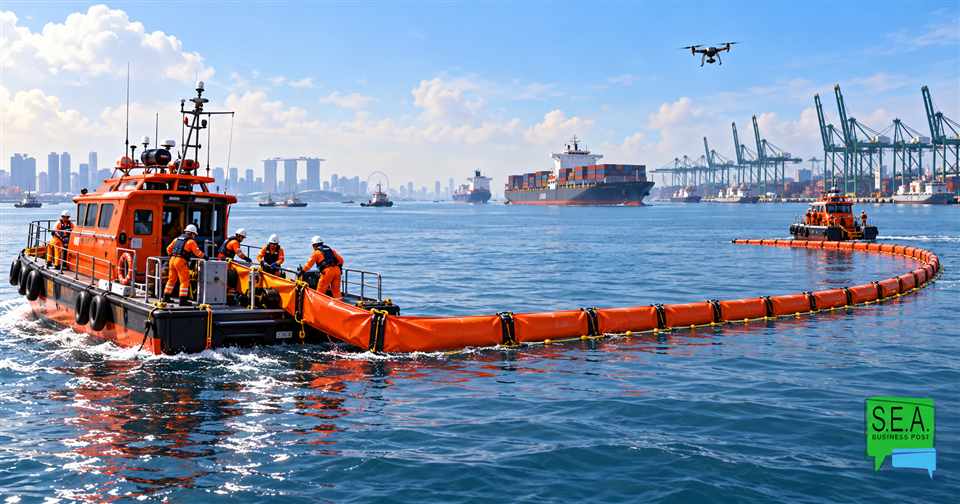
Participants explored concepts involving unmanned aircraft and surface vessels, including trials with ST Engineering. These concepts included aerial surveillance guiding surface craft in dispersant spraying and towing containment booms. MPA described them as developing capabilities, rather than a fully established autonomous response service.
SBP analysis: coordination is part of business resilience
For shipping operators, terminal managers and businesses dependent on marine deliveries, the exercise offers a practical reminder: emergency plans need to work across organisational and national boundaries.
A shared operating picture could help responders decide where to deploy scarce resources. Businesses reviewing their own plans can ask who receives an incident alert, how changing conditions reach operational teams and which decisions require coordination with external authorities.
The announcement does not quantify reduced disruption, cost savings or commercial contracts. Those outcomes should not be assumed from a drill or technology demonstration alone.
Featured image: AI-generated illustration of a maritime oil spill response exercise; it does not depict the actual JOSE 2026 event.