







Why could the Johor Regent’s Singapore land face a huge S$2 billion bill?
Johor Regent Tunku Ismail Sultan Ibrahim is reportedly seeking buyers for 16.6 hectares of prime Singapore land near the Botanic Gardens. But a potentially multibillion-dollar Land Betterment Charge has emerged as a major issue for what could become one of the city-state’s biggest property deals.
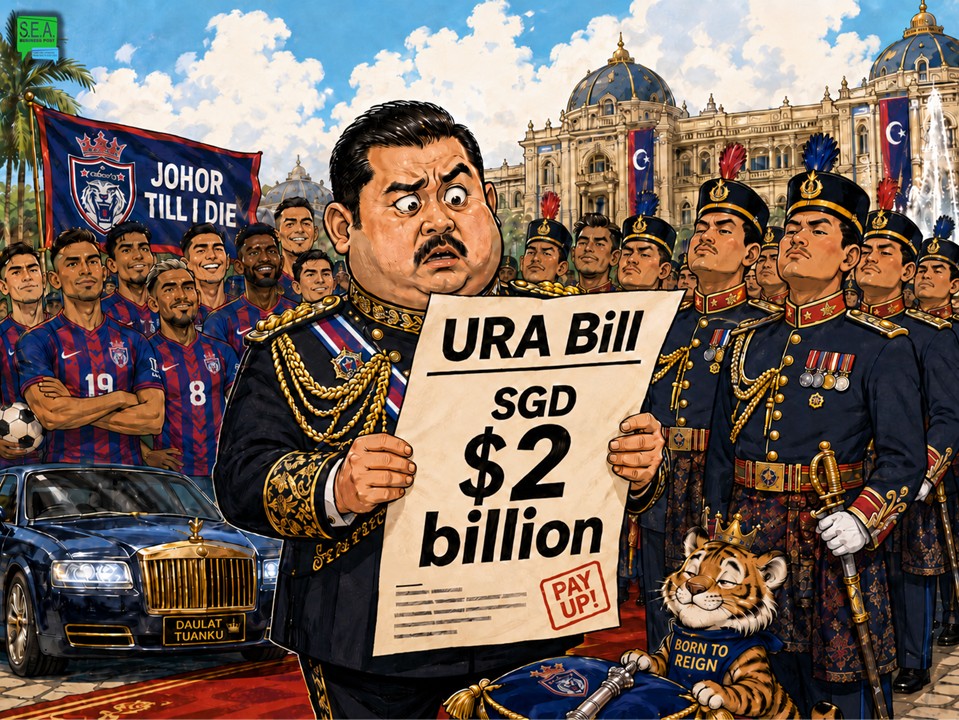
SINGAPORE — A vast parcel of prime land owned by Johor Regent Tunku Ismail Sultan Ibrahim is attracting fresh attention after reports that a Singapore land tax potentially exceeding S$2 billion could complicate efforts to sell the property.
Tunku Ismail is seeking buyers for 16.6 hectares, or about 41 acres, of land around Holland Road and Tyersall Avenue, according to Bloomberg reporting carried by The Business Times and South China Morning Post on Sept. 3.
Representatives have approached potential buyers, including parties outside Singapore, while the allocation of a possible Land Betterment Charge, or LBC, has become a sticking point in some discussions, according to people familiar with the talks.
Three property analysts estimated the charge could exceed S$2 billion, The Business Times reported. The figure is an analyst estimate, however, rather than a final tax assessment issued by the Singapore authorities.
What land does the Johor Regent own in Singapore?
Tunku Ismail currently controls two adjoining parcels at Holland Road totalling 16.6 hectares.
The present landholding followed a swap announced by the Singapore Government in June 2025.
Before the exchange, Tunku Ismail owned 21.1 hectares comprising two parcels known as Plots B and C. The Johor royal family had held the land privately for generations.
Under the arrangement, Tunku Ismail transferred the 13-hectare Plot C, which is closer to the Singapore Botanic Gardens, to the Singapore Government. In exchange, Singapore transferred an 8.5-hectare state-owned parcel, Plot A, to him.
He retained the existing 8.1-hectare Plot B, giving him the current 16.6 hectares across Plots A and B.
Singapore’s Urban Redevelopment Authority said at the time that the parcels exchanged were of “comparable value”.
Why did Singapore swap land with the Johor Regent?
The swap was designed to move future development farther away from the Singapore Botanic Gardens, a UNESCO World Heritage Site.
Singapore said Plot C, which it received from Tunku Ismail, would be kept undeveloped for the time being.
The exchange did not amount to blanket approval for development of the Regent’s remaining property. URA said any development would still be subject to the normal planning process and environmental requirements.
What does Tunku Ismail want to build on the land?
In March 2026, URA disclosed that Tunku Ismail had submitted a development application for low-rise, low-density housing with a gross plot ratio of 1.4, as well as Good Class Bungalows.
URA proposed rezoning Plots A and B from their previous uses to residential.
The agency said the plans had been reviewed with technical agencies and were compatible with the surrounding residential neighbourhood and existing height restrictions protecting views around the Botanic Gardens.
Part of the site would also be designated as a Good Class Bungalow Area if the rezoning is approved.
That potential transformation — from land with restricted development parameters into a large residential site — is central to the multibillion-dollar tax question now surrounding the property.
What is Singapore’s Land Betterment Charge?
The Land Betterment Charge is a tax on the increase in the value of land arising from certain government approvals, such as planning permission.
Singapore introduced the current system in August 2022, replacing several earlier development-related charges.
In simple terms, if a planning decision allows a property owner to use land more intensively or for a more valuable purpose, part of that increase in land value can be captured by the government through the LBC.
The Singapore Land Authority says that where a proposed development results in an increase in land value, it can issue the taxable person a liability order stating how much must be paid.
Does Tunku Ismail definitely owe S$2 billion?
No final S$2 billion liability has been publicly confirmed.
The figure reported this week comes from estimates by Singapore property analysts rather than a published liability order from the Singapore Land Authority.
The eventual amount can depend on factors including the property’s permitted use, development intensity, applicable geographical sector, valuation methodology and the planning approval ultimately granted.
That distinction matters because describing the S$2 billion estimate as an already-issued “tax bill” could imply greater certainty than currently exists.
The issue has also become more significant because Singapore revised its LBC rates with effect from Sept. 1, 2026. Average rates increased 3.5% for landed residential use and 3.4% for non-landed residential use, although the actual calculation for an individual site depends on its circumstances.
Who would pay the Land Betterment Charge — Tunku Ismail or the buyer?
This may be the most important question surrounding any potential transaction.
Under Singapore’s Land Betterment Charge framework, liability is governed by the ownership and planning circumstances when a chargeable consent takes effect.
Commercially, however, sellers and buyers can take the cost into account when negotiating a transaction.
Bloomberg reported that Tunku Ismail wants a buyer to bear the charge and that the potential size and uncertainty of the levy have become concerns in discussions with some prospective buyers.
That means the headline sale price alone would not necessarily reveal the full economic cost of acquiring and developing the site.
For a developer, the relevant calculation would include the purchase price, any LBC payable, construction and financing costs, infrastructure requirements and the eventual value of homes that could be sold.
Is the Johor Regent definitely selling the Holland Road land?
A completed sale has not been announced.
Tunku Ismail has explored a transaction since at least 2025, when representatives approached developers and potential buyers, according to earlier Bloomberg reporting.
At that stage, possibilities reportedly included selling some or all of the property or retaining a minority interest in a future development.
The latest reporting indicates that efforts to find buyers have continued, but negotiations do not guarantee a transaction.
Why does the Johor Regent land deal matter?
The numbers alone make the site exceptional.
It combines 16.6 hectares in one of Singapore’s most valuable residential districts, proximity to the Botanic Gardens and the possibility of luxury housing and Good Class Bungalows — an asset class where available land is extremely scarce.
But the bigger question extends beyond a royal property transaction.
The case illustrates how Singapore’s planning system determines who captures the increase in value when restrictions on highly valuable land are changed.
For any buyer, the crucial figure may therefore not be simply: “What does the Johor Regent want for the land?”
It may be:
After paying for the land, planning uplift and development, how much value is left for the developer?
The answer to that question is likely to determine whether one of Singapore’s most unusual pieces of privately owned land ultimately changes hands.