









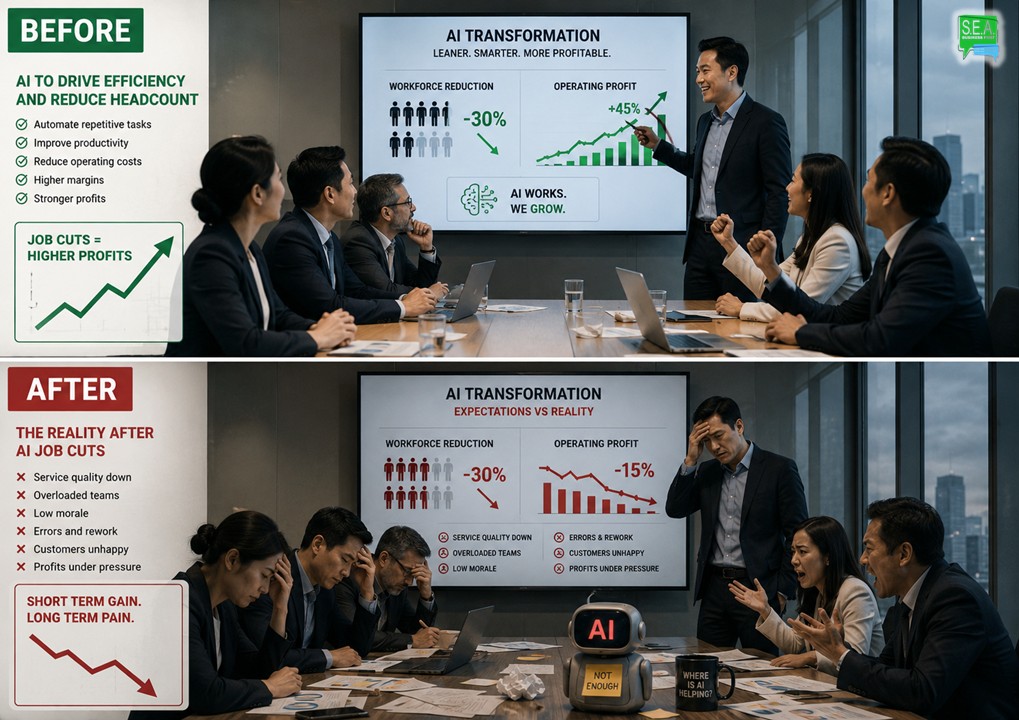
The Dangerous Illusion Behind AI Job Cuts
As artificial intelligence (AI) becomes a boardroom priority, an increasingly familiar corporate narrative is emerging. Companies announce artificial intelligence adoption plans alongside workforce reductions, presenting the technology as a route to leaner operations, stronger margins and improved productivity. Investors often respond positively, attracted by the promise of lower costs and faster efficiency.
Yet a more important question sits beneath the enthusiasm. Are companies treating AI as a genuine operational transformation, or merely as a justification for cutting jobs?
The distinction matters because AI’s capabilities, while significant, are often misunderstood. Artificial intelligence can automate repetitive administrative tasks, assist with coding, summarise information and handle straightforward customer queries. But replacing individual tasks is not the same as replacing broader organisational capability.
The spreadsheet logic versus business reality
The assumption behind many AI-linked job cuts appears simple. If employees become more productive with artificial intelligence tools, fewer workers should be needed to deliver the same output. On paper, the mathematics is attractive. A company that reduces headcount while preserving revenue improves profitability almost immediately, creating exactly the kind of efficiency story investors like to hear.
Business operations, however, do not function according to spreadsheet assumptions alone.
Employees are not merely task executors. They hold institutional knowledge, manage unusual exceptions, exercise judgement, keep up customer relationships and solve problems that do not fit neatly into standard workflows. These forms of expertise are difficult to quantify, which is precisely why they are often underestimated.
The central management mistake is confusing task automation with capability replacement.
Klarna’s operational reality check
Klarna offers one of the clearest examples of how this thinking can unravel. The Swedish payments company became one of the most visible corporate advocates for AI-driven productivity, promoting the technology’s ability to handle substantial customer service workloads. The message was clear. Automation could reduce labour requirements while preserving service quality.
The market welcomed the narrative.
But customer service is not simply a throughput exercise. It involves trust, empathy and judgement, particularly when dealing with sensitive financial disputes or distressed customers. Klarna later shifted towards increasing human customer support, suggesting that automation alone could not fully deliver the customer experience the business required.
The lesson was not that artificial intelligence had failed. The lesson was that management assumptions about what could realistically be automated had been overly aggressive.
Duolingo’s reputational warning
Duolingo demonstrates a different kind of risk. The language learning company’s AI-focused positioning triggered backlash because users interpreted the strategy as prioritising automation over educational quality and human expertise.
Language learning depends heavily on trust, nuance and cultural accuracy. While artificial intelligence can help generate content and improve personalisation, customers may react negatively if they believe automation is being used primarily as a cost-cutting mechanism rather than a product enhancement tool.
In some sectors, reputational damage can emerge before operational problems become visible.
A more measured approach
Not every company is making the same mistake. IBM has taken a more measured approach, using artificial intelligence to automate selected back-office functions while continuing to invest in strategic human roles. This reflects a more realistic understanding of the technology’s strengths and limitations.
AI is highly effective at certain repeatable processes. That does not mean it can replace every capability attached to a role.
This distinction matters because the greater risk lies in cutting ahead of actual readiness.
When companies move too fast
A company that removes large numbers of employees based on projected AI productivity gains may discover that implementation is far messier than expected. Tools may be unreliable, workflows may remain poorly designed, staff may be inadequately trained and governance may be weak.
Instead of becoming more efficient, the organisation can become less productive as remaining employees spend time correcting AI-generated errors, covering missing responsibilities and managing operational disruption.
The aviation industry offers a cautionary example. Air Canada faced legal scrutiny after its chatbot provided incorrect fare information to a customer. While not a workforce reduction case, it demonstrated how flawed automation in customer-facing functions can create expensive liabilities.
The same principle applies more broadly. Cheap automation can become costly when trust and accuracy matter.
The short-term market trap
This is what makes AI-linked layoffs particularly seductive. Short-term market reactions often reward immediate cost reductions because they are easy to model. Lower labour costs create a cleaner profit story.
But medium-term business performance can tell a different story.
Service quality deteriorates. Customers leave. Internal morale weakens. Managers become overstretched. Execution suffers.
By the time management realises rehiring, restructuring or restoring human oversight is necessary, the damage may already be difficult to reverse.
Why Southeast Asia should pay attention
This issue is especially relevant in Southeast Asia, especially Singapore and the Philippines where many sectors remain labour-intensive, including outsourcing, shared services, logistics administration and banking operations. Companies facing cost pressure may be tempted to use AI as a rapid workforce reduction strategy.
That would be a dangerous oversimplification.
Artificial intelligence can undoubtedly improve productivity, but successful adoption requires workflow redesign, staff adaptation and realistic expectations. The companies most likely to benefit will not be those that cut jobs the fastest. They will be those that understand AI as an operational tool, not a redundancy programme.