







Why the Madani Government is Failing by Still Using the Outdated T20, M40, B40 Classification Amid Global Crises
Rethinking Malaysia’s Income Classification
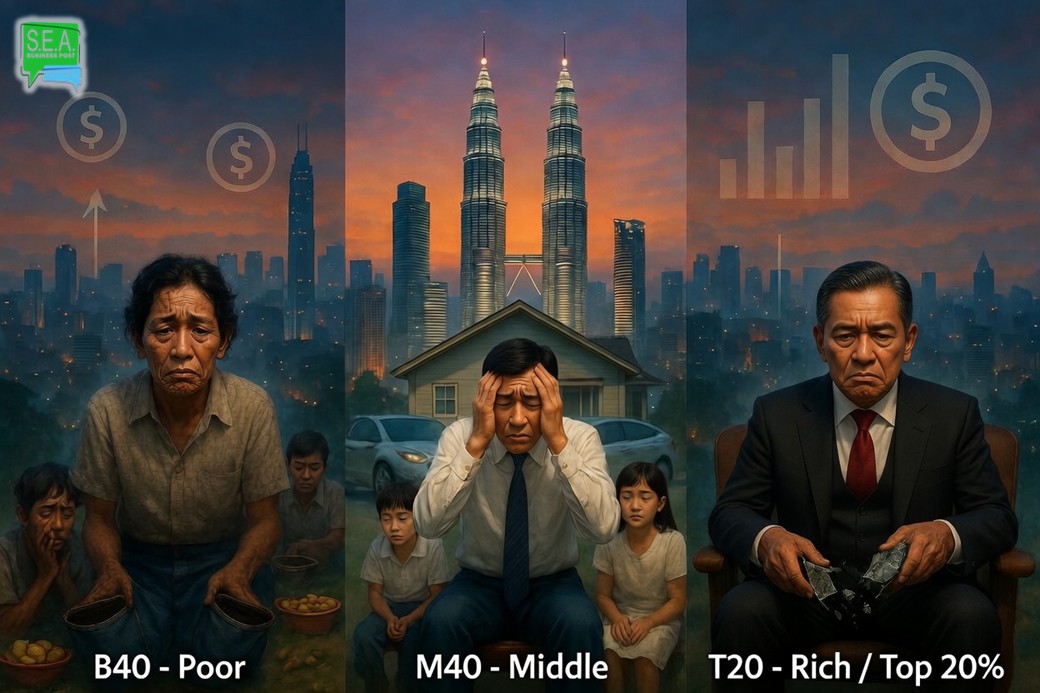
In Malaysia, households have traditionally been classified into three income groups: B40, M40, and T20. The B40 represented the bottom 40 percent of income earners, M40 the middle 40 percent, and T20 the top 20 percent. This system emerged in the early 2000s and became more formalized under Prime Minister Najib Razak in the 2010s, as policymakers sought a simple way to target subsidies, welfare programs, and economic initiatives. By separating households into three broad brackets, the government could design cash transfer schemes, housing programs, and education support to reach those most in need.
Why the Original System Made Sense
During Najib’s administration, the T20, M40, and B40 framework made strategic sense. Malaysia’s economy was growing steadily, the middle class was expanding, and income inequality, while present, could be addressed using broad categories. Programs such as BR1M, or Bantuan Rakyat 1Malaysia, relied on these classifications to deliver assistance efficiently.
Najib’s approach was smart because it simplified complex economic realities into actionable categories, allowing social programs, housing, and tax incentives to reach households effectively. Under this system, households earning below RM4,000 per month were classified as B40, those earning RM4,000 to RM8,000 as M40, and households above RM8,000 as T20. This simplicity made it easier for both government agencies and the public to understand who benefited from policies, especially in urban and semi-urban areas.
Why the Three-Tier Classification No Longer Works
Today, however, the three-tier system is increasingly outdated. Malaysia’s economy has changed dramatically, shaped by the pandemic, global conflicts, rising inflation, and rapid changes in lifestyle and cost of living. Households that might have been comfortably middle class a decade ago are now struggling with higher expenses and debt. The broad ranges of B40, M40, and T20 fail to capture these variations. A family earning RM4,500 in Kuala Lumpur may face financial pressure, while a similar income in a rural area can afford a comfortable lifestyle.
The T20 group now contains both ultra-rich elites and upper-middle-income households, reducing the effectiveness of policies aimed at the wealthy. Meanwhile, the M40 group is increasingly squeezed, making the traditional middle class label misleading. Continuing to rely on this outdated system ignores current economic realities and leaves many households misclassified and underserved.
A Modern Five-Class System
To better reflect the realities of modern Malaysia, the country could adopt a five-class income system. The lower end would include households classified as Struggling, representing those facing extreme financial hardship, and Vulnerable households, who are above extreme poverty but remain highly exposed to economic shocks. The middle class would be represented by Stable households, which have moderate disposable income and a measure of financial security. The upper tier would be split into Affluent households, representing upper-middle-income earners with significant disposable income, and Elite households, the ultra-wealthy top earners who hold substantial economic influence.
In terms of population percentages, Struggling households could make up around 20 percent, Vulnerable households another 20 percent, Stable households approximately 40 percent, Affluent households around 15 percent, and Elite households the top 5 percent.
Benefits of the New Classification
This revised classification allows for more precise policy design. The bottom 40 percent, now divided into Struggling and Vulnerable households, can be targeted with differentiated social assistance, while the middle 40 percent, Stable households, can be supported through measures aimed at preserving the middle class. The top 20 percent, divided into Affluent and Elite groups, can be addressed with progressive taxation and wealth-targeted policies. This approach also accommodates regional disparities, household size, debt levels, and cost-of-living differences, creating a more nuanced and fair system.
Policy Failure and Path Forward
Malaysia’s original T20, M40, and B40 classification served its purpose in the 2010s, and Najib’s use of it was smart for the economic realities of that time. However, in today’s environment, shaped by the pandemic, inflation, global conflicts, and rapidly changing lifestyles, this system no longer accurately reflects households’ financial situations. The continued reliance on the outdated classification by the current Madani government is a glaring policy failure. By refusing to adapt the framework, the government risks misallocating subsidies, misjudging household needs, and leaving both vulnerable and middle-income families underserved.
Adopting a modern five-class system with Struggling, Vulnerable, Stable, Affluent, and Elite categories would allow policymakers to accurately target assistance, taxation, and economic development programs, ensuring that every household is properly classified and supported in today’s complex economic landscape.