








ASEAN Islamic Finance Poised for Massive Growth Spurt. May Top US$2 Trillion by 2035
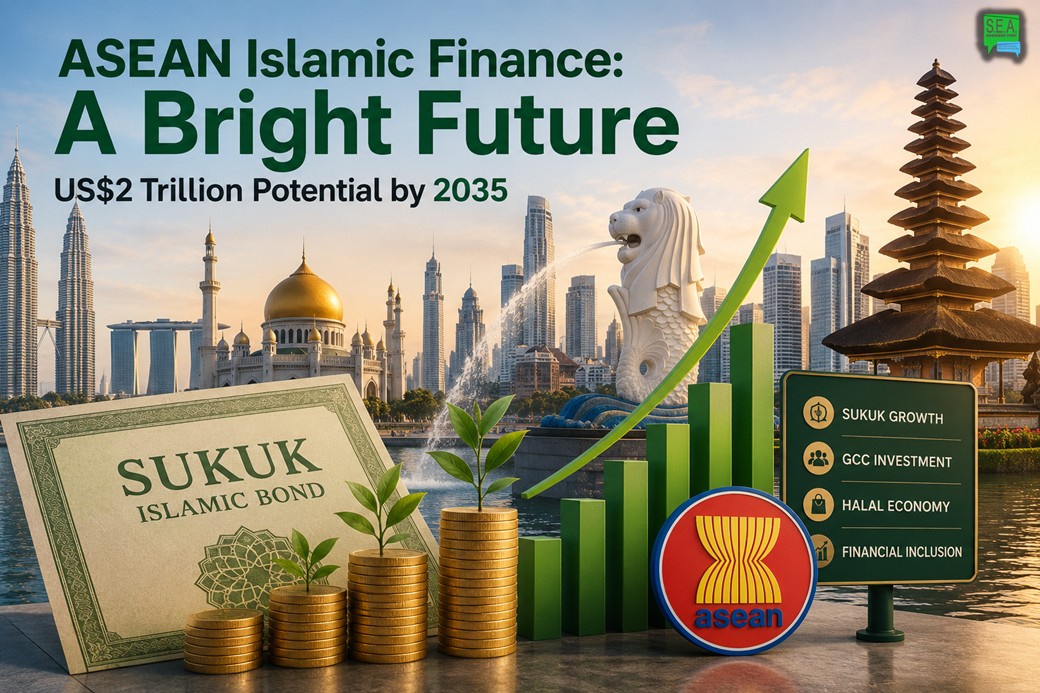
The ASEAN Islamic finance industry is expected to cross the US$1 trillion mark by the end of 2026 according to Fitch Ratings. The industry reached nearly US$950 billion by mid-2025 with Malaysia, Indonesia, and Brunei accounting for the majority of assets. This milestone confirms Southeast Asia as one of the world’s fastest-growing regions for Shariah-compliant finance.
With this growth momentum, analysts are now asking a bigger question: could ASEAN’s Islamic finance industry reach US$2 trillion by 2035? The answer depends on both expanding existing markets and bringing underdeveloped countries into the Islamic finance ecosystem.
Concentrated Markets Drive Growth
Today, Malaysia, Indonesia, and Brunei dominate ASEAN Islamic finance. Malaysia is the largest market with approximately US$300 billion in assets, and Islamic financing represents 42 percent of total banking system financing. Indonesia has Islamic banking assets of about US$56 billion, equal to 7 percent of its banking sector. Brunei’s Islamic banks held nearly US$10 billion in assets at the end of 2024, representing 63 percent of the country’s banking assets.
These three countries have established a mature Islamic finance ecosystem spanning banking, takaful, asset management, and sukuk issuance. However, the rest of ASEAN remains largely untapped. Islamic finance has limited presence in Singapore, Thailand, and the Philippines while Vietnam, Laos, Cambodia, and Myanmar are underdeveloped due to regulatory constraints and smaller Muslim populations. This fragmentation represents both the industry’s challenge and its largest opportunity.
Sukuk as a Growth Engine
ASEAN’s sukuk market is a key factor for long-term growth. Outstanding sukuk issuance reached US$475 billion by mid-2025, representing 16 percent of the region’s debt capital market. Malaysia and Indonesia account for nearly all sukuk issuance in ASEAN and together represent 47 percent of the global sukuk market.
Sukuk are Islamic financial certificates that function similarly to bonds but comply with Shariah principles, which prohibit interest payments. Instead of earning interest, investors receive returns generated from ownership stakes in underlying assets, projects, or business activities.
Sukuk financing is increasingly linked to infrastructure, energy transition, and sustainable development projects. ESG sukuk is also growing, allowing ASEAN issuers to attract both Islamic investors and global ESG-focused funds. The alignment between Shariah principles and sustainable finance positions ASEAN for long-term asset growth.
GCC Investment and Cross-Border Opportunities
Investment from Gulf Cooperation Council (GCC) countries is another catalyst for ASEAN Islamic finance. As Gulf investors seek diversification, Southeast Asia offers strong demographics, growing consumer markets, and relative political stability.
ASEAN countries could channel GCC capital into infrastructure, renewable energy, logistics, and halal economy projects through sukuk and Shariah-compliant investment vehicles. Greater investment ties between ASEAN and the GCC could expand the industry’s asset base over the next decade.
Integration Across ASEAN
The biggest challenge to reaching US$2 trillion is market fragmentation. Different regulatory frameworks, Shariah standards, and financial structures create barriers to cross-border growth. Fitch Ratings highlights that more interconnected ASEAN financial systems could support greater Islamic finance penetration.
Harmonized regulations, common standards for Islamic financial products, and streamlined cross-border sukuk issuance would enable Malaysia and Indonesia to expand into neighboring markets. A more integrated ASEAN Islamic finance ecosystem would provide investors with broader opportunities while driving the region toward the US$2 trillion goal.
The Road to US$2 Trillion
Reaching US$2 trillion will take time but the pathway is clear. Rising Muslim populations, growing wealth, expanding sukuk markets, stronger ASEAN-GCC investment links, fintech innovation, and the growth of the halal economy all support long-term growth.
The expected US$1 trillion milestone in 2026 is not the peak of ASEAN Islamic finance. It could mark the start of a new growth phase that, if ASEAN successfully connects its fragmented markets and attracts international capital, leads to a US$2 trillion industry by 2035.
ASEAN Islamic finance is poised to become a global hub for Shariah-compliant banking, sukuk, and investment products, offering opportunities for investors, policymakers, and entrepreneurs to participate in a rapidly expanding market.