









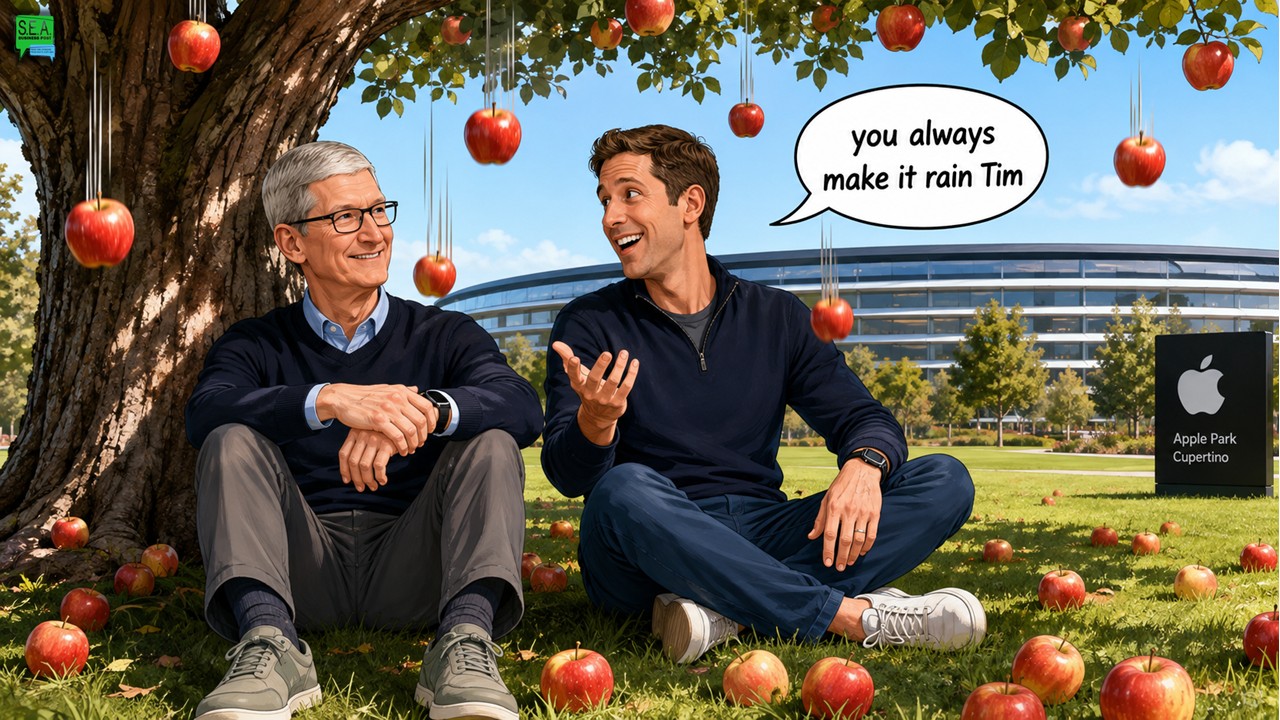
Apple’s Biggest Leadership Shake-Up: Why Engineer John Ternus Is Replacing Tim Cook in 2026
John Ternus has replaced Tim Cook as Apple CEO after 15 years. The choice of a hardware engineer signals what Apple believes it needs next: stronger product innovation, deeper control of technology and a response to the AI revolution. But why did Tim Cook make sense in 2011, why does Ternus make sense now, and what could change at Apple?
CUPERTINO, California: Apple has entered only its third major leadership era since Steve Jobs returned to the company and transformed it into the technology giant it is today.
On September 1, 2026, John Ternus officially became CEO of Apple, replacing Tim Cook after 15 years at the top. Cook has not left the company. He has moved into the role of executive chairman, while Ternus has joined Apple’s board of directors.
Apple said the transition was unanimously approved by its board following a long-term succession process.
But the more important question is not simply who replaced Tim Cook. It is why Apple has chosen an engineer to lead the company now.
When Steve Jobs stepped down in 2011, Apple needed an executive capable of turning extraordinary products into an enormous, reliable global business. Tim Cook was that executive.
Fifteen years later, Apple is already one of the world’s biggest and most profitable companies. Its challenge is different. Apple now needs to prove that it can lead the next technological era, particularly artificial intelligence, while finding new products capable of eventually reducing its dependence on the iPhone.
That helps explain why John Ternus makes sense now.
Who is John Ternus, Apple’s new CEO?
John Ternus is a mechanical engineer and longtime Apple executive who previously ran the company’s hardware engineering organisation.
He joined Apple’s product design team in 2001 and became vice president of Hardware Engineering in 2013. In 2021, he joined Apple’s executive leadership team as senior vice president of Hardware Engineering.
During his career, Ternus has overseen hardware engineering across the iPhone, Mac, iPad, Apple Watch and other products. Apple says he was instrumental in the development of multiple product categories, including the iPad and AirPods.
Before joining Apple, Ternus worked as a mechanical engineer at Virtual Research Systems. He holds a bachelor’s degree in mechanical engineering from the University of Pennsylvania.
That background matters because Apple has not chosen a finance chief, a sales executive or an external technology CEO to succeed Cook. It has chosen someone whose career has been built around the physical products that define the company.
Why was Tim Cook the right choice for Apple in 2011?
The circumstances Apple faced in 2011 were very different from those it faces today.
When Steve Jobs stepped down, Apple already had extraordinary products. The iPhone was transforming mobile computing, the iPad had created a new category and the App Store was becoming increasingly important.
Apple did not primarily need someone to invent another Steve Jobs. It needed someone who could scale what Jobs had created.
Cook was unusually well suited to that task. Before becoming CEO, he had been Apple’s chief operating officer and was responsible for worldwide sales and operations, including the company’s supply chain, manufacturing relationships and distribution.
Apple’s board said in 2011 that Cook’s 13 years at the company had demonstrated outstanding performance and sound judgment. Before joining Apple in 1998, he had worked at Compaq and spent 12 years at IBM, including roles involving manufacturing, fulfilment and inventory management.
That experience was exactly what Apple needed. Jobs had proved that people wanted Apple’s products. Cook’s challenge was to make sure Apple could manufacture, distribute and profit from them at an unprecedented scale.
And by almost any financial measure, that strategy worked.
What did Tim Cook accomplish at Apple?
When Cook became CEO in 2011, Apple was worth approximately US$350 billion. By the time of his transition to executive chairman, Apple’s market value had reached roughly US$4 trillion to US$4.5 trillion.
Apple’s annual revenue also grew dramatically during his tenure, while the company expanded beyond hardware into a much larger services business. Apple Watch, AirPods, Apple Pay, Apple Music, Apple TV and iCloud all became more important parts of the company during the Cook era.
Cook also helped make Apple less dependent on single-product cycles. Services grew into a business generating more than US$100 billion annually, while Apple expanded its installed base to more than 2.5 billion active devices.
Cook’s greatest legacy may therefore be that he transformed Apple from a company with blockbuster products into one of the most disciplined and profitable ecosystems in global business.
But that success created a different problem for his successor.
Apple now has scale. What it needs next is another wave of invention.
Why did Apple choose an engineer as CEO?
This may be the most important question surrounding Ternus’s appointment.
Apple could have selected an executive with a background in finance, operations, software, services or sales. Instead, it chose its hardware engineering chief.
That decision appears to signal that Apple believes product technology will be central to its next chapter.
Ternus has spent roughly 25 years working inside Apple’s product organisation. He understands how the company designs hardware, how its engineering teams operate and how different technologies come together inside products such as the iPhone, Mac and Apple Watch.
Apple’s board specifically cited his leadership, technical knowledge and focus on creating products when announcing him as Cook’s successor.
The timing is significant too.
Apple is entering an era where AI is increasingly moving from software running in data centres into phones, computers, wearables and potentially entirely new categories of devices. Hardware and AI are beginning to converge.
An engineer who understands chips, batteries, displays, sensors, thermal management and product design could therefore be particularly relevant.
Does choosing Ternus mean Apple wants to become more innovative?
It certainly suggests that product innovation is becoming a bigger leadership priority.
That does not mean Apple believes Cook failed. His achievements turned Apple into one of the most valuable companies ever created.
But Apple’s extraordinary financial success has created a new problem. Investors increasingly want to know where the company’s next major growth engine will come from.
Apple remains heavily dependent on the iPhone ecosystem. Its attempt to build an electric vehicle was abandoned. Vision Pro demonstrated significant technical ambition but has not yet become a mass-market product. At the same time, artificial intelligence has reshaped competition across the technology industry.
Reuters Breakingviews argued that Ternus’s challenge will be to combine some of Cook’s operational discipline with the type of product ambition associated with Jobs.
That is probably the clearest way to understand the appointment.
Cook was the right CEO when Apple’s biggest problem was scale.
Ternus may be the right CEO now because Apple’s biggest problem is invention.
What is John Ternus’s biggest challenge?
Artificial intelligence is likely to be his biggest immediate strategic challenge.
AI is rapidly changing smartphones, search, software development, personal assistants and cloud computing. Rivals have invested aggressively in AI infrastructure, models and consumer products.
Apple has introduced its own AI technologies, but it still faces pressure to demonstrate that AI can become a genuine competitive advantage across its products.
For Ternus, the question is not simply whether Apple can build a better chatbot. It is whether Apple can make AI useful enough that consumers want to buy new Apple devices because of it.
That is where his engineering background may matter most.
Apple’s traditional advantage has always been the integration of hardware, software and silicon. If the next phase of AI competition moves into devices, wearables and new forms of personal computing, Ternus could be leading Apple into a battle that is as much about hardware as software.
What could happen to Apple under John Ternus?
In the short term, probably less than people expect.
Apple will continue selling iPhones, Macs, iPads, watches and services. Its supply chain will keep operating. Its retail stores will remain open. Its existing executives will continue running major parts of the business.
The more meaningful changes are likely to emerge slowly.
Ternus’s influence will become visible through which projects receive investment, which products survive internal development, how aggressively Apple approaches AI and what new hardware categories eventually reach consumers.
Those decisions could determine the direction of Apple for the next decade.
What could happen to the iPhone?
The iPhone is unlikely to become less important anytime soon. It remains the centre of Apple’s ecosystem and a major source of revenue.
But Ternus may face pressure to make the iPhone feel more dramatically different from one generation to another.
Apple is expected to hold its first major product event of the Ternus era on September 9, 2026, and industry speculation has focused on major form-factor changes, including the possibility of foldable devices.
If Apple does move into foldables, it would be particularly symbolic. Ternus would be beginning his CEO tenure with one of the most significant physical changes to Apple’s most important product in years.
But the larger question is whether the iPhone itself can continue carrying so much of Apple’s growth.
Can John Ternus find Apple’s next iPhone?
That may ultimately determine how his tenure is remembered.
Tim Cook inherited the iPhone and turned it into the foundation of a global business worth trillions of dollars.
Ternus inherits a different problem. The iPhone is already mature, the smartphone market is mature and Apple therefore needs to find new ways to grow without damaging the business that made it so successful.
Ternus does not necessarily need to create one product as transformative as the original iPhone.
But investors will expect Apple to demonstrate that it can still create major new sources of growth.
Possible areas across the technology industry include AI-first devices, wearables, health technology, robotics, spatial computing and entirely new forms of personal computing.
It would be speculation to say which category Apple will ultimately prioritise. But the pressure to create a major new platform will be considerable.
Is Tim Cook still involved with Apple?
Yes.
Cook is now Apple’s executive chairman.
That means Ternus will continue to have access to Cook’s experience, particularly in areas where Cook has been exceptionally strong, including supply chains, government relations and international business.
Cook’s continued presence could make the CEO transition smoother, but it also creates a governance question.
Ternus will need enough independence to establish himself as the company’s true chief executive.
Reuters Breakingviews has noted that keeping Cook close could help Ternus, but that former CEOs remaining too involved can sometimes complicate leadership transitions.
Who replaced John Ternus as Apple’s hardware chief?
Apple has appointed Johny Srouji as chief hardware officer, expanding his responsibilities following Ternus’s move to CEO.
Srouji has been one of the key executives behind Apple’s custom silicon strategy.
The change means Ternus can move away from directly managing hardware engineering and concentrate on running the entire company.
How much is John Ternus paid as Apple CEO?
Ternus’s compensation package includes an annual base salary of US$3 million, according to Reuters.
His targeted stock award for fiscal 2027 is worth approximately US$55 million, with a significant portion linked to performance.
Cook, in his new executive chairman role, will receive an annual salary of about US$2 million and a targeted equity award worth approximately US$45 million.
How old is John Ternus?
Ternus is 51 years old.
His age is relevant because Apple may have selected someone capable of leading the company for many years.
Cook became CEO at 50 and ultimately held the job for 15 years. If Ternus follows a similar trajectory, he could potentially shape Apple well into the 2030s.
What are the biggest risks facing Apple’s new CEO?
Ternus inherits several major risks.
AI is developing rapidly, and Apple cannot afford to fall permanently behind. China remains both an important market and a crucial part of Apple’s supply chain. Manufacturing diversification is expensive and complex. Governments around the world continue scrutinising Apple’s App Store, privacy rules, payments systems and market power.
Apple also faces the challenge of convincing customers to upgrade increasingly expensive devices when older products remain capable.
At the same time, investors expect Apple to keep producing extraordinary profits.
Those expectations give Ternus very little room for major mistakes.
What should investors watch under John Ternus?
Five questions are likely to define his early tenure.
Can Apple turn AI into something consumers genuinely value?
Can Apple create another major hardware category?
Can Ternus make the iPhone exciting enough to sustain upgrades?
Can Apple diversify manufacturing without sacrificing margins or quality?
And can Ternus establish his own authority while Tim Cook remains executive chairman?
The answers may tell investors much more than Apple’s next quarterly earnings report.
Why does the John Ternus appointment matter?
The CEO transition reveals something important about how Apple views itself.
In 2011, Apple selected the executive who knew how to operate and scale an increasingly enormous company.
That was Tim Cook, and the decision worked spectacularly.
Apple is now larger, richer and more globally powerful than the company Cook inherited.
But scale is no longer Apple’s biggest problem.
Its biggest question is what comes next.
By choosing John Ternus, Apple has placed an engineer at the top of the company at precisely the moment when technology is undergoing its biggest shift since the smartphone revolution.
That may be the clearest signal yet about Apple’s priorities.
Cook was the CEO Apple needed to scale the iPhone era. Ternus now has to prove he is the CEO Apple needs to create whatever comes after it.
This reads much more naturally while keeping the subheads AI-friendly. I’d use this version over the more fragmented FAQ style.