









Shady world of Phantom Workers in Singapore: What the Recent MOM Raid Reveals
Singapore’s Ministry of Manpower (MOM) has stepped up enforcement against companies suspected of using phantom workers in Singapore to inflate their foreign worker quotas.
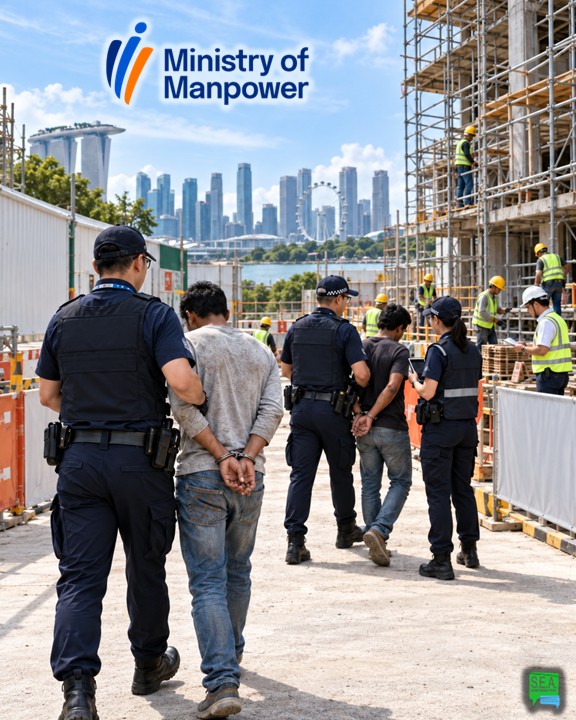
On 2 September 2026, MOM carried out an enforcement operation in the construction sector. Four people were arrested, including two company directors and two company staff. Another 21 individuals are assisting with investigations.
According to MOM, the directors are suspected of making fraudulent Central Provident Fund (CPF) contributions to locals who were not genuinely employed by their companies.
These individuals were allegedly used as phantom workers to increase the companies’ local workforce numbers, allowing them to employ more migrant workers than their actual workforce would otherwise support.
What Is a Phantom Worker in Singapore?
A phantom worker is someone declared as an employee even though he or she does not genuinely work for the company. CPF contributions may be made under that person’s name, creating the appearance of a legitimate employment relationship.
This matters because Singapore’s foreign worker quota system takes a company’s qualifying local workforce into account when deciding how many foreign workers it may employ.
Why Do Companies Use Phantom Workers?
The main reason is usually to increase the company’s foreign worker quota. A company may try to make it appear that it employs more local workers than it actually does.
Instead of hiring genuine employees and paying their full salaries and employment costs, an unscrupulous employer may make CPF contributions for people who do not actually work there. Those individuals then appear in employment records as local workers.
The company may then use that inflated local workforce count to support applications for additional foreign workers.
How Do Companies Benefit From Phantom Workers?
The potential benefit is simple: access to more foreign manpower at a lower cost.
A genuine employee involves salary, CPF contributions, leave and other employment expenses.
With a phantom worker arrangement, an employer may try to incur only part of those costs while still benefiting from the appearance of having additional local employees.
For labour-intensive industries such as construction, manufacturing and food and beverage, access to foreign manpower can directly affect operating capacity.
What Happened in the September 2026 MOM Raid?
The latest operation involved companies in Singapore’s construction sector. MOM arrested two company directors and two company staff, while another 21 individuals are assisting with investigations. The directors are suspected of making fraudulent CPF contributions to locals who were not genuinely employed.
MOM is also investigating suspected false declarations and possible employment-related kickbacks under the Employment of Foreign Manpower Act. At this stage, the matters remain under investigation.
Was This an Isolated Case?
No.
The September raid followed another major MOM operation in July 2026.
In that case, 14 people were arrested, including company directors, foreign workers and a key appointment holder from an employment agency. MOM said it was investigating suspected fraudulent CPF contributions involving 139 locals who were not actually employed by the companies.
Those individuals may also have been used as phantom workers to inflate foreign worker quotas.
This shows that phantom worker arrangements are receiving active enforcement attention.
Are Phantom Workers Illegal in Singapore?
Using false employment arrangements to inflate a foreign worker quota can breach the Employment of Foreign Manpower Act. Employers may face financial penalties, prosecution and restrictions on hiring foreign workers.
MOM has stated that employers can face penalties of up to S$20,000 for every work pass application made using an inflated quota. Companies may also be debarred from employing foreign workers.
For businesses that rely heavily on foreign manpower, this can have a serious operational impact.
Can the Phantom Worker Get Into Trouble?
Yes.
A person who knowingly allows his or her identity to be used in a phantom worker arrangement may also face enforcement action.
For example, someone who agrees to receive CPF contributions despite not genuinely working for the company may be treated differently from a person whose identity was used without consent.
The important issue is whether the individual knowingly participated in the arrangement.
Can You Be a Phantom Worker Without Knowing?
Potentially, yes.
Someone may discover CPF contributions from a company he or she has never worked for.
Individuals should therefore check their CPF transaction history and investigate unexpected contributions from unfamiliar employers. If CPF contributions appear from a company you have never worked for, the matter should be reported to the relevant authorities.
How Does MOM Detect Phantom Workers?
Authorities can use data analytics, inspections, complaints and employment records to identify suspicious arrangements.
Investigators may compare CPF contributions with payroll records, salary payments, employment contracts and actual job duties. This means creating an employment record on paper does not necessarily make the arrangement legitimate.
Why Are Phantom Workers a Problem?
Phantom workers undermine Singapore’s foreign worker quota system. They can also give dishonest companies an unfair advantage over competitors that genuinely employ the required number of local workers.
For legitimate employers, the rule is straightforward: foreign worker quotas should reflect the company’s real workforce, not just the workforce shown on paper.
Recap
What is a phantom worker?
A phantom worker is someone recorded as an employee even though the person does not genuinely work for the company.
Why do companies use phantom workers?
One common reason is to inflate the company’s local workforce count so that it can employ more foreign workers.
Do phantom workers receive CPF?
In many cases, CPF contributions may be made to create the appearance that the person is genuinely employed.
Can companies be fined?
Yes. Employers may face financial penalties, prosecution and restrictions on hiring foreign workers.
Final Thoughts
The latest MOM phantom worker raid in Singapore shows that fraudulent workforce declarations are under serious scrutiny.
Four people were arrested in September 2026, just weeks after another major investigation involving suspected CPF contributions to 139 locals who were allegedly not genuinely employed.
For companies, the attraction may be clear: an inflated local workforce can potentially provide access to more foreign manpower.
But the legal, financial and reputational risks are equally clear. A worker who exists only on paper is not the same as a genuine employee.