









What is a good salary in Singapore in 2026? New MOM benchmarks show how PMET pay varies by age and industry
Is S$10,000 a good salary in Singapore?
SINGAPORE: A monthly salary of S$10,000 may put a worker comfortably above many peers in one Singapore industry, while leaving another below a government benchmark for relatively highly paid professionals.
New salary benchmarks released by Singapore’s Ministry of Manpower in August 2026 show just how sharply professional pay differs by both age and industry, offering workers an unusually detailed reference point for comparing salaries across the economy.
The figures form part of the C1 Salary criterion under Singapore’s Complementarity Assessment Framework, or COMPASS, which is used to assess Employment Pass applications.
For each age and sector, MOM lists the salary corresponding to the 65th percentile of local PMETs, which earns an applicant 10 COMPASS points, and the 90th percentile, which earns 20 points. PMETs refer to professionals, managers, executives and technicians.
While the benchmarks are intended for the Employment Pass system, they also provide a useful indication of how salaries differ among local professionals by age and sector.
And the numbers suggest there is no simple answer to the question of what constitutes a “good salary” in Singapore.
At 30, a ‘good salary’ can range from S$5,000 to more than S$13,000
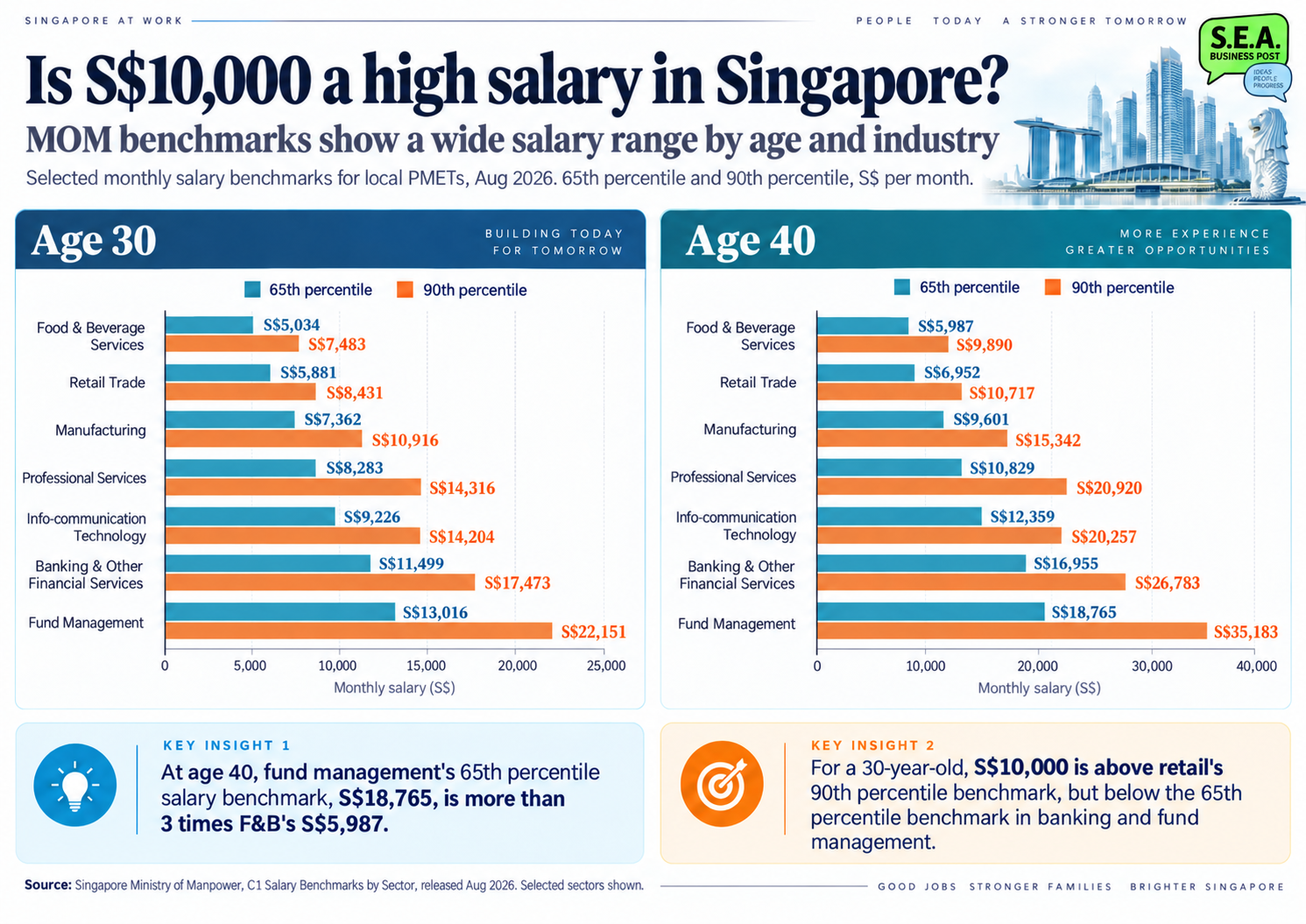
For a 30-year-old, MOM’s 65th-percentile salary benchmark ranges from S$5,034 a month in food and beverage services to S$13,016 in fund management and activities auxiliary to financial services.
Retail trade sits at S$5,881, manufacturing at S$7,362, professional services at S$8,283 and information and communications technology at S$9,226.
The corresponding benchmark is even higher in finance, at S$11,499 in banking and other financial services.
The differences become larger at the 90th percentile.
For 30-year-olds, MOM’s 90th-percentile benchmark is S$7,483 in F&B services and S$8,431 in retail, compared with S$14,204 in ICT, S$17,473 in banking and S$22,151 in fund management.
That means two workers of the same age earning the same salary can occupy very different positions relative to the salary benchmarks for their industries.
Is S$10,000 a month a high salary in Singapore?
The MOM data illustrates why the answer depends heavily on industry.
For a 30-year-old working in retail, S$10,000 a month is above the sector’s S$8,431 salary benchmark for the 90th percentile.
But in banking, the 65th-percentile benchmark for the same age is already S$11,499.
In fund management, it is S$13,016.
In other words, a salary that appears high when viewed across the wider workforce may not necessarily be high within a particular professional sector.
That distinction becomes even more pronounced for older workers.
Salary benchmarks rise sharply with age
MOM’s figures increase with age across every industry in the tables, reflecting the higher salaries generally associated with more experienced workers.
In ICT, for example, the 65th-percentile benchmark rises from S$7,033 for workers aged 23 or younger to S$9,226 at age 30, S$10,793 at age 35 and S$12,359 at age 40.
For workers aged 45 and above, it reaches S$13,926 a month.
The progression is steeper in banking.
The benchmark rises from S$7,680 for those aged 23 or younger to S$11,499 at 30, S$14,227 at 35 and S$16,955 at 40.
For workers aged 45 and above, MOM sets the 65th-percentile benchmark at S$19,683.
The figures help explain why an older Employment Pass applicant may need a substantially higher salary than a younger applicant to receive the same number of salary points under COMPASS.
They also provide local workers with a way of comparing their pay against an age-adjusted benchmark rather than relying solely on economy-wide median salaries.
Finance sits in a salary league of its own
The highest benchmarks in the MOM tables are found in fund management and related financial-services activities.
At age 40, the 65th-percentile benchmark in that sector is S$18,765 a month, while the 90th-percentile benchmark is S$35,183.
For workers aged 45 and above, the figures rise to S$21,639 and S$41,699, respectively.
Banking is also among Singapore’s highest-paying sectors.
At age 40, the benchmarks are S$16,955 at the 65th percentile and S$26,783 at the 90th percentile. For those aged 45 and above, they reach S$19,683 and S$31,437.
Other sectors show much lower thresholds.
At age 40, the 65th-percentile benchmark is S$5,987 in F&B services, S$6,952 in retail trade, S$7,629 in construction and S$9,601 in manufacturing.
Professional services comes in at S$10,829, while ICT is S$12,359.
The comparison means the 65th-percentile benchmark for a 40-year-old in fund management is more than three times the equivalent figure in F&B services.
What should a 35- or 40-year-old earn in Singapore?
For workers trying to benchmark their own pay, the MOM figures suggest that age alone is not enough.
A 35-year-old’s 65th-percentile benchmark ranges from S$5,511 in F&B services and S$6,417 in retail to S$9,556 in professional services, S$10,793 in ICT, S$14,227 in banking and S$15,891 in fund management.
At age 40, the same benchmarks rise to S$5,987 in F&B, S$6,952 in retail, S$10,829 in professional services, S$12,359 in ICT, S$16,955 in banking and S$18,765 in fund management.
The implication is that salary comparisons based only on age, such as asking what the “average 35-year-old” earns, can obscure major differences between industries.
The gap is not only between industries
MOM’s tables also reveal large differences between the 65th and 90th percentiles within the same sector.
In professional services, a 40-year-old’s benchmark rises from S$10,829 at the 65th percentile to S$20,920 at the 90th percentile.
In real estate services, the comparable figures are S$8,087 and S$17,230.
In insurance, reinsurance, provident and pension funding, they are S$11,084 and S$22,835.
The spread is particularly wide in financial services, suggesting a significant gap between relatively well-paid professionals and workers at the upper end of the salary distribution.
By comparison, the 40-year-old benchmarks in retail are S$6,952 and S$10,717, while in F&B services they are S$5,987 and S$9,890.
What the numbers do, and do not, tell workers
The benchmarks provide a useful reference for Singaporeans asking whether their salary is relatively high for their age and sector.
But they should not be treated as a precise individual salary calculator.
A worker earning above MOM’s published 65th-percentile benchmark can say their salary exceeds the salary level MOM associates with that benchmark for their age and industry.
It would be misleading, however, to infer an exact percentile for salaries that fall between the two published thresholds. MOM’s tables provide the 65th- and 90th-percentile salary points, not the full underlying salary distribution.
The figures also apply at the sector level, meaning they do not account for differences between individual occupations, companies, job grades or responsibilities within the same industry.
Still, the data provides something relatively rare: an official age-adjusted view of professional salaries across a wide range of Singapore industries.
For workers asking whether S$8,000, S$10,000 or S$15,000 a month is a “good” salary, MOM’s latest benchmarks suggest the better question may be:
Good for what age, and in which industry?