





BBM’s Debt Surge Rekindles Debate Over the Philippines’ Borrowing Legacy
Philippine President Ferdinand “Bong Bong” Marcos, widely known as BBM, has approved a ₱4 billion emergency loan programme aimed at supporting micro, small and medium enterprises, but the move has reignited debate over the country’s rapidly expanding debt burden and revived comparisons with the borrowing legacy of his father.
The latest financing package is designed to provide relief for smaller businesses facing elevated operating costs and economic uncertainty. On its own, the ₱4 billion facility is relatively minor against the scale of the Philippines’ overall public obligations. However, politically, the announcement has renewed scrutiny over how much debt the current administration has accumulated.
When BBM took office in June 2022, the Philippines’ national government debt stood at approximately ₱12.8 trillion. By early 2026, that figure had climbed to roughly ₱18.5 trillion, according to official treasury figures.
That represents an increase of around ₱5.7 trillion in less than four years, or approximately 44.5%.
For critics, the pace of debt expansion is alarming. For supporters, the numbers require context.
Debt Expansion Under BBM
Government borrowing does not necessarily indicate fiscal distress. Debt levels can rise because of deficit financing, infrastructure spending, refinancing of maturing obligations and shifts in currency valuations.
The Philippines entered the BBM administration already carrying a heavy debt burden after the pandemic years, when aggressive borrowing was used to support the economy.
Nevertheless, the increase remains significant.
A 44.5% jump in total national debt during one presidency places BBM among the most aggressive debt-expanding Philippine administrations in nominal terms, even though part of the increase reflects inherited structural pressures rather than entirely new spending commitments.
The current administration maintains that today’s debt structure is fundamentally different from past crises. A substantial portion of the debt is domestically sourced, reducing reliance on foreign lenders and limiting exposure to external currency shocks.
For investors, sustainability remains the more important metric than absolute debt totals. The Philippines retains investment-grade standing, and its debt servicing remains manageable, though rising global interest rates have made borrowing more expensive.
The Shadow of Ferdinand Marcos Sr.
The debate inevitably draws comparisons with BBM’s father, former president Ferdinand Marcos Sr., whose borrowing programme remains one of the most controversial fiscal legacies in Philippine history.
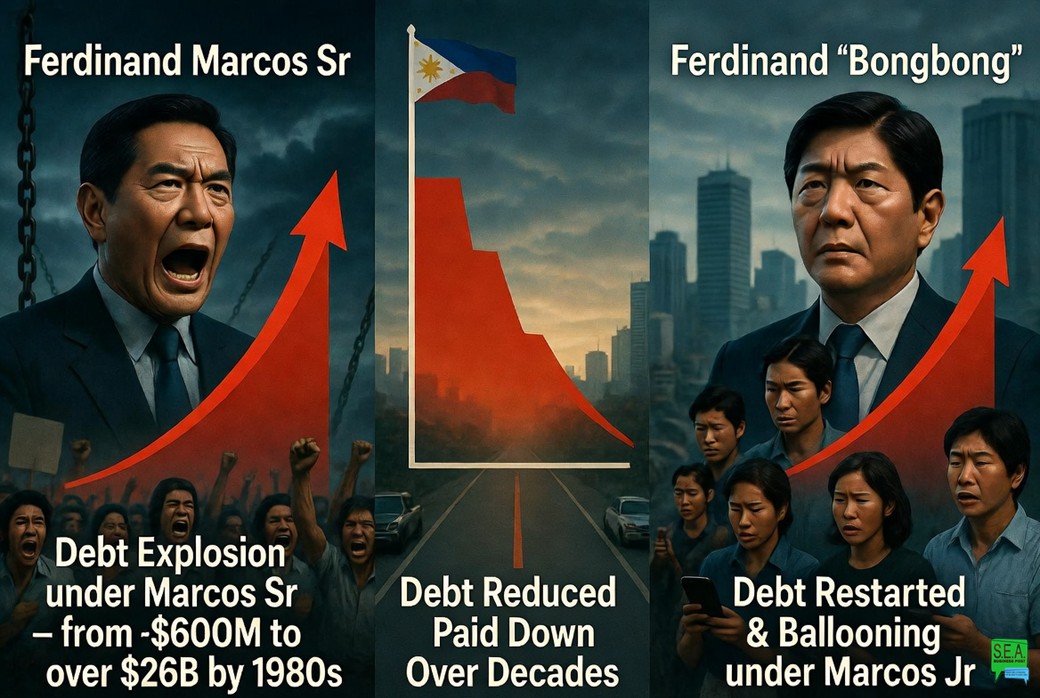
When Marcos Sr. assumed office in 1965, the country’s foreign debt was relatively modest. By the end of his rule in 1986, external debt had surged to more than US$28 billion.
The expansion was driven by infrastructure ambitions, industrial projects such as the Bataan Nuclear Plant and state-backed development plans, but also by politically connected ventures that later became associated with corruption allegations and economic inefficiency.
The borrowing spree contributed to the Philippines’ debt crisis in the early 1980s, forcing painful restructuring and economic intervention.
What made the debt especially politically toxic was not simply its size, but its longevity.
A Debt Burden That Lasted Generations
Debt linked to the Marcos Sr. era continued weighing on Philippine public finances for decades after his removal from office.
Some obligations tied to that period reportedly continued to be serviced into the 2020s, meaning taxpayers born long after the dictatorship were still helping repay liabilities incurred under his administration.
That historical reality gives today’s borrowing debate greater emotional and political resonance.
Critics argue that rapidly rising debt under BBM raises uncomfortable historical echoes, even if the fiscal circumstances are markedly different.
Supporters reject direct comparisons, arguing that today’s democratic institutions, stronger treasury oversight and deeper domestic capital markets make the analogy misleading.
Different Times, Same Political Optics
The Philippines today is not facing the sovereign debt emergency of the 1980s.
Its economy is more diversified, fiscal oversight is stronger and financing structures are more transparent.
Yet political symbolism remains difficult to ignore.
One Marcos left behind debts that took decades to address. Another Marcos is now overseeing record debt levels, even if under very different economic conditions.
The ₱4 billion MSME loan is small in budgetary terms. The larger question is whether BBM’s broader borrowing trajectory will generate enough economic growth to justify the long-term cost.