









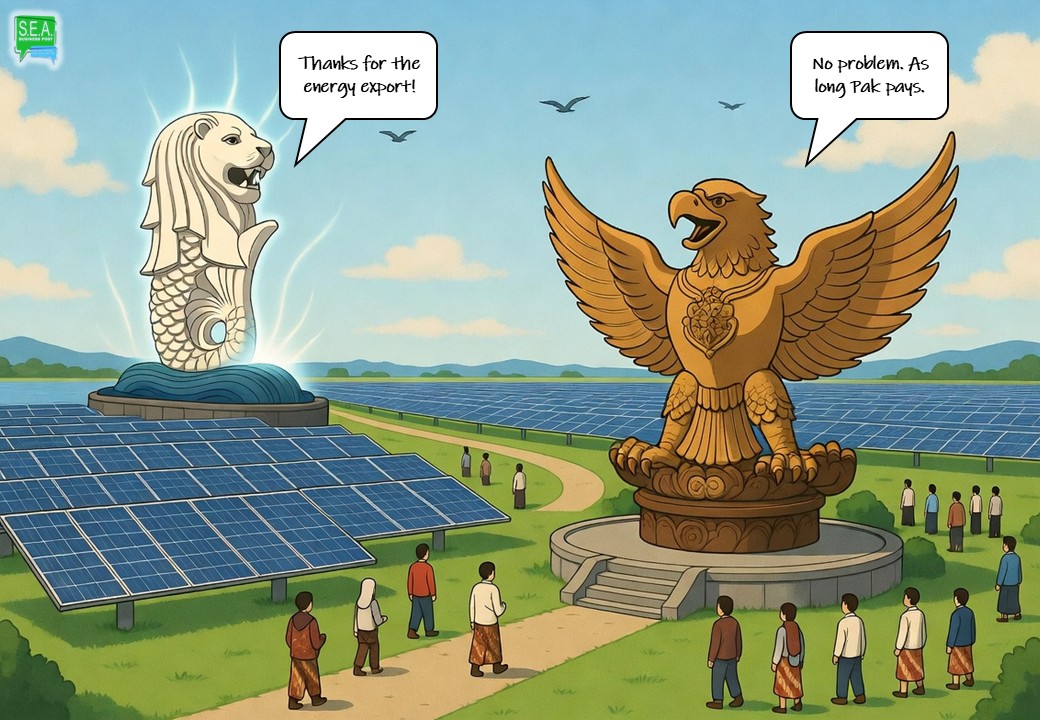
Danantara’s $30 Billion Solar Project: A Gateway to Clean Energy Exports to Singapore
Indonesia’s newly established sovereign wealth fund, Danantara, is set to lead a $30 billion solar energy project aimed at harnessing Indonesia’s abundant solar resources. This transformative initiative is not only set to bolster Indonesia’s renewable energy sector but also pave the way for clean electricity exports to Singapore, positioning Indonesia as a key player in Southeast Asia’s energy transition.
Indonesia’s Renewable Energy Vision
The Danantara Solar Project will focus on the development of large-scale solar farms in regions like the Riau Islands and Sumatra, which are perfect locations for solar energy due to their high levels of sunlight. These solar plants will generate significant amounts of clean power, which will be transmitted to Singapore, addressing the city-state’s growing need for low-carbon electricity.
This collaboration is part of a broader effort by both countries to meet climate goals. Singapore aims to import at least 30% of its energy from low-carbon sources by 2035. By tapping into Indonesia’s vast renewable resources, both nations can meet their energy and environmental commitments, supporting the ASEAN clean energy transition.
The Role of Danantara
Danantara, established to drive national investments in strategic sectors, will play a central role in making the solar project a reality. It will act as a conduit for international investment, enabling the development of solar infrastructure and the creation of jobs in renewable energy.
The project’s scale is ambitious, with plans to produce up to 3.4 gigawatts of clean electricity by the mid-2030s. This energy will not only be used to meet Indonesia’s domestic demand but will also provide Singapore with a sustainable and reliable power supply.
Why Singapore?
Singapore, despite being a regional economic powerhouse, faces constraints in generating renewable energy locally due to limited land and resources. This is where Indonesia’s vast solar potential comes in. Singapore has turned to its neighbors, including Indonesia, to help meet its energy needs. The partnership will allow Singapore to import green electricity, helping it reduce dependence on fossil fuels while advancing its sustainability goals.
Singapore plans to import around 4 gigawatts of low-carbon electricity by 2035, and Indonesia’s solar project could be a key contributor to this target. The solar farms in Indonesia will offer a clean, green solution that fits well within Singapore’s long-term energy strategy, which includes increasing solar installations and developing clean energy imports.
Overcoming Challenges
While the project holds great promise, there are several challenges that must be addressed before it can be fully realized. Building cross-border transmission lines to deliver the electricity to Singapore is both costly and complex. Additionally, regulatory frameworks surrounding pricing, tariff structures, and grid access will need to be ironed out to ensure smooth operations.
Negotiations are underway between Indonesia’s state utility PLN, Danantara, and Singapore’s Energy Market Authority (EMA). These discussions aim to create a framework that ensures both countries benefit from the arrangement and that the cost of exporting electricity remains competitive.
Despite these hurdles, both governments are optimistic about the project’s future. Some agreements have already been made, with conditional approvals for the first phases of energy imports from Indonesia to Singapore.
Economic and Environmental Impact
The Danantara Solar Project will have significant economic implications for Indonesia. It will generate thousands of jobs in the renewable energy sector, from solar panel manufacturing to infrastructure development and the operation of solar farms. This will help boost Indonesia’s economy and further its green industrialization efforts, making it a key player in the renewable energy export market.
For Singapore, importing low-carbon electricity from Indonesia will help reduce the country’s carbon footprint, contributing to its climate goals and strengthening its energy security. The project could also serve as a model for other regional energy partnerships.
What to expect from this Solar Project
The Danantara Solar Project is an exciting initiative that could reshape the energy landscape in Southeast Asia. While it is still in the planning stages, the project has the potential to revolutionize clean energy exports between Indonesia and Singapore, serving as a model for cross-border energy cooperation in ASEAN.
However, its success depends on overcoming regulatory, technical, and financial challenges. With continued government commitment and international investment, the project could significantly impact both countries’ energy strategies and accelerate the transition to a low-carbon future in Southeast Asia.