








Massive Oil Discovery Fuels Vietnam’s Economic Growth
Vietnam’s offshore oil discovery by Murphy Oil comes at a critical inflection point for the country. With economic growth running close to 8 percent, Vietnam is expanding faster than almost any economy in Asia. Manufacturing output is rising, exports are accelerating, and electricity demand is climbing sharply. This pace of growth is a success story, but it also exposes structural pressure on energy supply. In that context, the Murphy Oil discovery is less about headline barrels and more about buying Vietnam time.
The discovery strengthens Vietnam’s energy buffer at a moment when long-term solutions are still being built.
Who Is Murphy Oil
Murphy Oil is an independent US-based exploration and production company founded in 1950 and headquartered in Houston. Unlike the global oil majors, Murphy focuses on offshore and deepwater projects where capital discipline and technical execution matter more than sheer scale.
Its portfolio spans the Gulf of Mexico and parts of Southeast Asia, including Vietnam. Murphy’s continued presence offshore Vietnam reflects a long-term strategy built around mature basins that still offer commercial upside when paired with existing infrastructure.
The Discovery and Its Immediate Value
The discovery was made in the Cuu Long Basin, a region that historically anchored Vietnam’s oil production. While not a global mega-discovery, it is commercially meaningful for a country whose oil output has been declining for more than a decade.
Incremental domestic production helps reduce import dependence and cushions Vietnam against global energy price volatility. In a fast-growing economy, energy stability is not a luxury but a requirement. Without it, growth quickly runs into bottlenecks.
Juxtaposing Oil With Eight Percent Growth
Vietnam’s near 8 percent GDP growth reflects a surge in factories, industrial parks, logistics hubs, and urban development. All of this consumes power. Renewable energy is expanding rapidly, but it cannot yet fully meet baseload demand.
The Murphy Oil discovery functions as a stabiliser. It supports growth by ensuring fuel availability during periods of peak demand and grid stress. Rather than competing with renewables, oil acts as a bridge that allows Vietnam to sustain momentum while transitioning its energy mix.
People-Level Benefits
For ordinary Vietnamese, the benefits are indirect but tangible. Domestic energy supply helps moderate electricity and fuel prices, reducing the risk of sudden cost spikes that hit households and small businesses hardest.
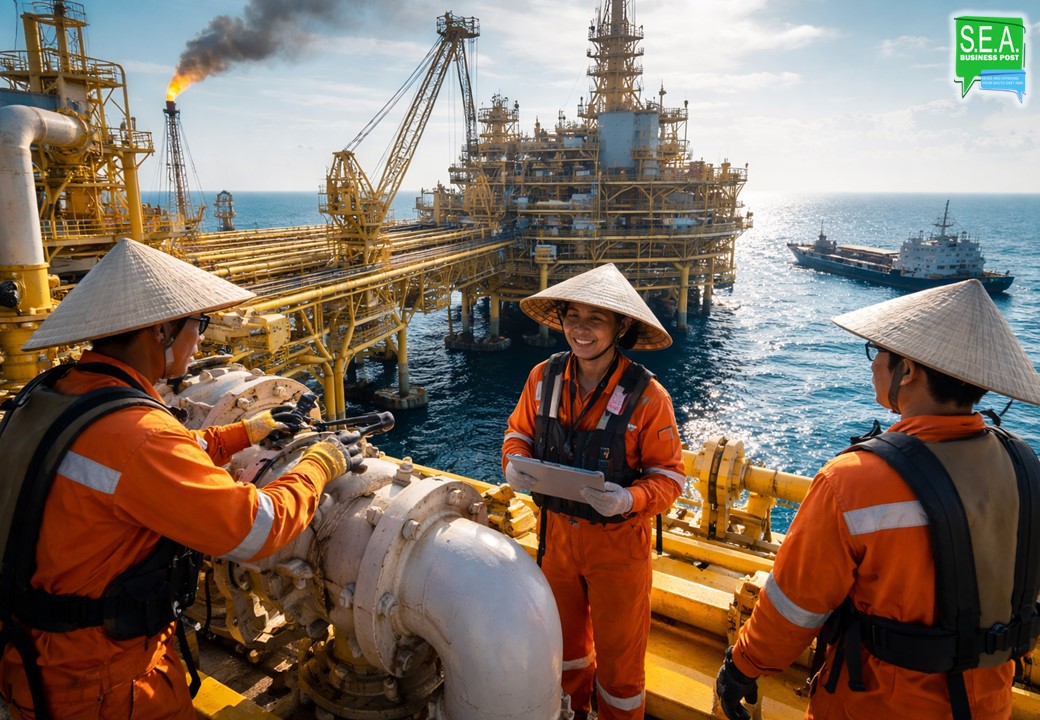
Offshore development creates skilled employment in engineering, marine services, logistics, and technical support. These jobs raise incomes and build expertise that strengthens the broader industrial workforce. Government revenues generated through production sharing help fund infrastructure, education, and healthcare without raising taxes.
In practical terms, energy stability protects living standards while growth accelerates.
Vietnam’s Nuclear Energy Plans
Vietnam has signalled renewed interest in nuclear power as part of its long-term energy strategy. Nuclear offers reliable baseload electricity with low carbon emissions, but it requires years of planning, regulatory preparation, financing, and public consensus.
Even under optimistic timelines, nuclear power will not contribute meaningfully to Vietnam’s grid until well into the next decade. That gap between ambition and delivery creates near-term risk. The Murphy Oil discovery helps fill that gap by providing energy security while nuclear plans mature.
In this sense, oil does not delay Vietnam’s energy transition. It enables it.
From Former Oil Power to Renewed Relevance
Vietnam was once a major oil producer in Southeast Asia. In the 1990s and early 2000s, offshore fields drove production above 350,000 barrels per day, placing Vietnam alongside Indonesia and Malaysia.
As fields matured and exploration slowed, output declined and Vietnam slipped into mid-tier status. The Murphy discovery does not restore past dominance, but it reopens the path to relevance by proving that Vietnam’s offshore potential is not exhausted.
Buying Time for the Next Phase
This discovery should be viewed as strategic reinforcement rather than a windfall. It buys Vietnam time to build renewables, plan nuclear capacity, and upgrade its grid without sacrificing growth.
In an economy expanding at remarkable speed, time itself is a valuable commodity. The Murphy Oil discovery provides exactly that.