








Bondi Attack: Did they really train in the Philippines?
The deadly Bondi attack shocked Australia and drew immediate global attention. As with similar incidents, initial reporting focused on the victims, the unfolding investigation, and the response of security agencies. Very quickly, however, the tragedy became entangled in speculation that went well beyond what was known at the time.
Almost as soon as details began emerging, public commentary shifted from what happened to where the attackers supposedly came from and where they were allegedly trained. In that rush to explain motive and origin, accuracy was often displaced by assumption.
Claims of Philippine training and official denials
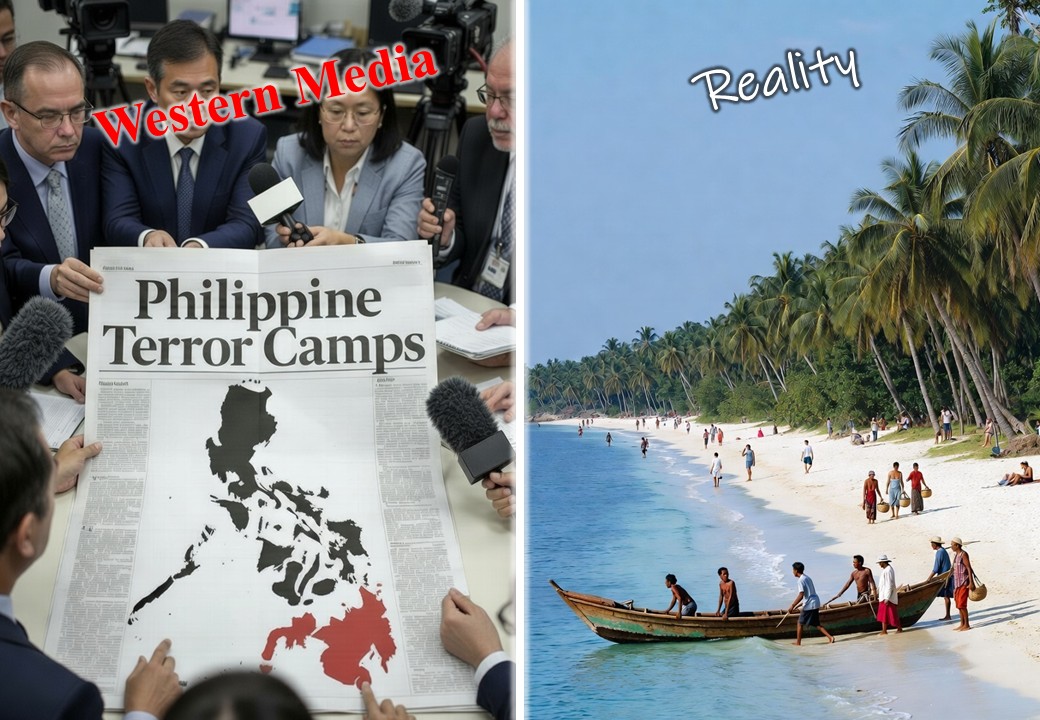
Among the most persistent claims was that the attackers had received terrorist training in the Philippines. Right-wing pundits and sections of Western media pointed to the country’s southern regions, particularly Mindanao, reviving familiar narratives that portray the Philippines as a training ground for Islamist militants.
These claims were explicitly rejected by the Armed Forces of the Philippines and the Philippine government. Security officials stated there was no validated intelligence linking the attackers to any form of militant training while in the country. They also dismissed portrayals of the Philippines as an ISIS training hub as inaccurate and outdated. Despite these denials, the narrative continued to circulate, amplified more by repetition than evidence.
Misreporting identities and national origins
The Philippines was not the only target of inaccurate reporting. In the days following the Bondi attack, several Western outlets and commentators described the attackers as being from Pakistan. That assertion also proved incorrect.
In fact, the son who carried out the attack was Australian, while the father was from India. Pakistan had no connection to the case. Yet it was quickly drawn into the story, reflecting a tendency to rely on identity shorthand rather than verification. Religion, nationality, and geography were compressed into a convenient narrative before basic facts were confirmed.
The Philippines as a convenient terrorism backdrop
The depiction of the Philippines as a terrorism hotspot follows a familiar pattern. It relies on assumptions formed decades ago rather than current security realities. Mindanao today operates under a layered framework of peace agreements, autonomous governance, and coordinated security mechanisms involving local authorities and the national government.
Reducing this environment to a generic incubator for jihadist violence ignores how significantly conditions have changed since the height of the insurgencies of the 1990s and early 2000s. It also overlooks the institutional arrangements that now exist to prevent extremist groups from regaining territory or influence.
Why pundits lump everything together
Right-wing commentary frequently lumps the Moro Islamic Liberation Front, the Moro National Liberation Front, the Bangsamoro Autonomous Region in Muslim Mindanao, Abu Sayyaf, and ISIS into a single category.
This happens for several reasons. It fits an ideological worldview that treats Islamist violence as a single, undifferentiated phenomenon. It simplifies complex political and security realities that do not translate easily into soundbites. It supports domestic political narratives that emphasise external threats rather than domestic radicalisation and online extremism. It avoids uncomfortable policy lessons about peace processes, autonomy, integration, and governance. It also draws heavily on outdated think tank talking points written for Western audiences and recycled without sufficient context.
From insurgency to security partnership
What this framing obscures is that these actors are not the same and, in many cases, stand on opposite sides of the security equation.
MILF and MNLF are no longer insurgent groups fighting the Philippine state. They are peace partners that signed formal agreements and now participate in governance through BARMM, a constitutionally recognised autonomous region. Today, these groups coordinate with the Armed Forces of the Philippines, support election security, and actively oppose ISIS linked cells that threaten regional stability. International observers widely regard the Bangsamoro peace process as a counterterrorism success because it reduced the political grievances that extremist groups once exploited.
Abu Sayyaf, by contrast, remains a criminal terrorist organisation. ISIS operates in the Philippines only through small, fragmented local cells, not through open training camps accessible to foreign visitors.
What the Bondi case really exposes
There is still no verified evidence linking the Bondi attackers to militant training in the Philippines. What the episode exposes instead is how quickly old narratives are revived when terrorism intersects with politics.
Blaming foreign training grounds is often more comfortable than confronting the reality that radicalisation today is frequently domestic, online, and difficult to detect. For Southeast Asia, the consequences of such misrepresentation are tangible. Lazy narratives distort country risk perception, undermine investor confidence, and delegitimise peace processes that have reduced violence.
Western media that continue to recycle these tropes are not clarifying the terrorism threat. They are obscuring it, and in doing so risk reinforcing the very policy failures they claim to warn against.